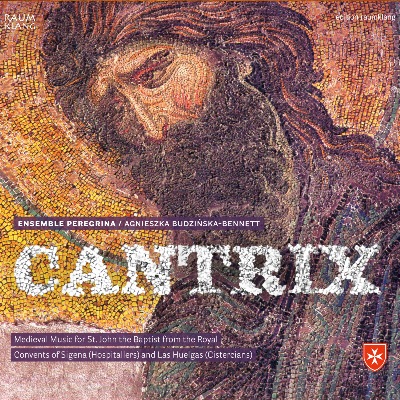
(Raumklang RK3204)
CD tracks, music pieces, text transcriptions and the booklet of pieces can be found in the Resources section of this website.
The Cantrix was a female singer at the Monastery of Sijena. Her duties were set out in the Rule of Sijena (1188). The roles of two other female singers, known as the Precentrix and the Paraphonista, were also defined in the Rule.
The Rule provides a detailed description of how the bells, which are musical instruments in their own right, should be used within the monastery. Remarkably, the Rule describes these musical functions in such detail that it seems as if the monastery was resounding with singing and bells all the time. As we discovered later, the acoustics of the monastery church are overwhelmingly beautiful. Queen Sancha and her husband, King Alfonso II of Aragon, were patrons of the arts and music. Peire Vidal, one of the most famous troubadours of this period, was generously supported by the Aragonese rulers, a favor he returned by praising Alfonso II's decision to marry Queen Sancha, a young woman from Castile, rather than Princess Eudoxia and her caravans of gold from Constantinople.
The central figure in the project is St John the Baptist, the patron saint of the Hospitallers.
By selecting pieces from the neighboring royal monastery of Las Huelgas in Castile, Ensemble Peregrina once again captured a comprehensive picture of the medieval landscape of Aragon, Castile, the Hospitallers, and the Cistercians in their musical performance.
„Un vrai trésor.“ (Supersonic Pizzicato, September/Oktober 2013)
„Lässt die Hohe Minne uns im Stich, so bleibt immer noch die Gottesminne. Wenn diese so schön gesungen aus dem CD-Player klingt, wollen wir uns gerne in andächtige Demut flüchten! Das Frauen-Ensemble Peregrina um Agnieszka Budzińska-Bennett widmet sich dem prophetischen Jesus-Vorgänger Johannes dem Täufer. Eine Quelle der hier erklingenden Musik ist das Kloster Sigena des Ordens des Heiligen Johannes von Jerusalem mit einstimmigen liturgischen Stücken. Diesen stellt Peregrina die raffiniert gesetzte frühe Mehrstimmigkeit aus dem Zisterzienserinnen-Kloster Las Huelgas entgegen. Ein reizvoller Kontrast verschiedener Kompositionsweisen, Denkansätze und Liturgien wird deutlich. Die klösterliche Welt vom 12. bis zum 15. Jahrhundert erstrahlt in ihren unterschiedlichen Facetten. Abgerundet wird die in bester Tonqualität und mit hohem musikalischen Anspruch umgesetzte Huldigung an die Schwestern aus Sigena und Las Huelgas überraschenderweise dann doch noch durch ein Minnelied: Der Trobador Peire Vidal lässt sein sein tieftrauriges, zärtliches "S'ieu fos en cort" erklingen in der Mitte des Albums, dazu wurde als Gast ein männlicher Sänger eingeladen: Mathias Spoery. Das Stück wurde ausgewählt, da es in der Schluss-Strophe des Liedes die Königin Sancha von Kastilien (ca. 1154 bis 1208) preist, sie ist eine der Gründerinnen des Frauenklosters Sigena. Das nur von Baptiste Romain stimmungsvoll auf der Vielle begleitete Trobadorlied wird gefolgt von einer schwungvoll interpretierten Estampie von Rostainh de Marselha, bis dann wieder die betörend schönen Frauenstimmen zur Johannespreisung zurückkehren.“ (www.minnesang.com, Dr. Lothar Jahn, August 2013)
« L’histoire nous raconte qu’il existât une Reine Sancha, figure éminente et tutélaire, ayant fondé un monastère à Sigena dans les environs de Huesca (Royaume d’Aragon). Un chœur de moniales, dominée par un chantre féminin y chantait des pièces monophoniques et polyphoniques : versets, répons, motets. Le programme de ce disque est composé d’extraits du fameux codex Las Huelgas, de pièces à l’attribution variée (dont des copistes et compilateurs). Les textes sont tirés des évangiles et relatent la vie et la figure de Saint Jean Baptiste, son lien particulier avec l’entourage de Jésus. Côté musique, on n’est pas sûr de déterminer sa singularité puisqu’elle emprunte mode compositionnel, instrumentarium (vielle à roue, cloches) à l’Ecole de Notre Dame. Deux chansons de troubadours complètent cet ensemble : « Sieu fos en cort » de Pieire Vidal et « La dousa paria » de Rostainh Berenguier, hommages dévoués et fervents à la Sainte Reine Sancha. Elles sont présentées ici sous forme d’estampie instrumentale et jouées à la vielle et à la harpe. Le chœur Peregrina (fondé à Bâle en 1997) s’est spécialisé dans la polyphonie médiévale, il est constitué de voix mixtes et internationales, ce qui ne confère pas une approche locale et idiomatique à cet enregistrement. L’intérêt est plutôt dans l’exigence de la thématique (Situation géographique, cohérence des sources, la femme-chantre, le personnage de Saint Jean Baptiste). Belle approche qui nous remémore cette figure du Cantrix qui officiait dans les monastères médiévaux. » (diapasoncd.com, Jérôme Angouillant, July 2013)
Dieser Text sollte durch Informationen über Sie und Ihr Unternehmen ersetzt werden.